
ADHD Hyperfocus Burnout Cycle: Why You Crash (And What to Do About It)
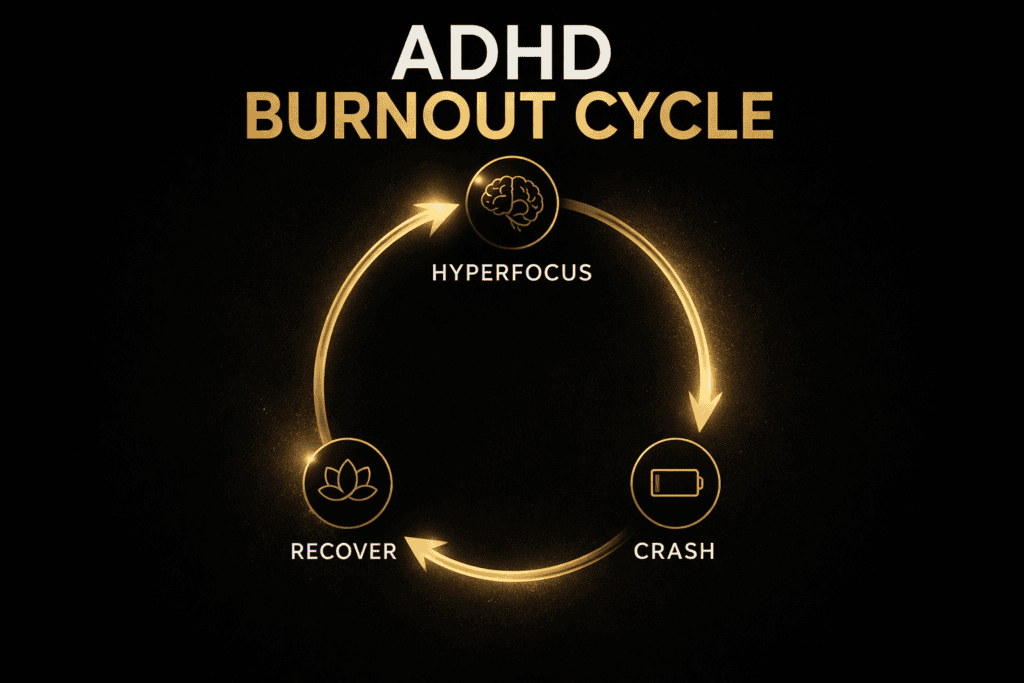
If you’ve experienced ADHD hyperfocus burnout… this is part of a wider pattern known as the ADHD hyperfocus burnout cycle.
At first, it can feel confusing.
One day, you’re working at a high level — focused, productive, even energised.
Then, without much warning, that state disappears.
Motivation drops.
Tasks feel heavier.
Even simple things require effort.
This isn’t random.
It follows a pattern.
In a previous article, I explained why high-performing professionals and entrepreneurs suffer from ADHD hyperfocus burnout… You can read that here if you haven't already: Why High-Performing ADHD Professionals Burn Out (And Why Productivity Advice Makes It Worse)
Today we're going to explore the 8 stages of the ADHD hyperfocus burnout cycle, how to recover once you reach ADHD burnout, and also what steps you can take to become more mindful in future.
The ADHD Hyperfocus Burnout Cycle (Step by Step)
To understand what’s happening, it helps to break the cycle into its 8 stages.
1. Activation
Something triggers the system:
-
a deadline
-
a new idea
-
urgency
-
interest
This increases dopamine and arousal, helping you initiate focus.
2. Hyperfocus
Attention narrows.
Distractions fade.
You enter a state of deep concentration.
Time becomes less relevant.
You may work for hours without noticing fatigue.
Performance can be extremely high.
But in the background:
→ regulation is being overridden
3. Accumulated Load
During hyperfocus, the system continues to consume resources:
-
mental energy
-
emotional energy
-
physiological capacity
But because attention is locked in, you may not notice:
-
tiredness
-
hunger
-
cognitive fatigue
So instead of adjusting…
you continue.
And in many ways, it makes sense.
After the initial resistance, you’re finally focused.
Finally in flow.
So the natural thought is:
“Why would I stop now?”
You may even feel like you’re making up for lost time.
But in that moment, your thinking shifts.
From long-term sustainability…
to:
“Now… or not now.”
And you ride the wave.
Hoping this time it will carry through without a cost.
But in reality, it’s like a Formula 1 driver refusing to pit-stop.
4. Threshold Breach
At a certain point, the nervous system reaches its limit.
This isn’t a conscious decision.
It’s biological.
Once that threshold is exceeded, your nervous system shifts.
And you stop — not because you chose to,
but because you have no choice
You reach what I call "the point of no return."
5. The Crash After Hyperfocus
This is what many describe as:
“ADHD crash after hyperfocus”
It can feel like:
-
sudden loss of motivation
-
difficulty starting tasks
-
low mental energy
-
emotional flatness or irritability
Importantly:
→ this is not failure
→ this is compensation
The nervous system is rebalancing after sustained overactivation.
Once you reach this point, there’s no negotiating with it.
It’s like coming down with an illness — you may want to keep going, but your body forces you to stop.
So what can you do at this stage?
In simple terms:
slow down — deliberately.
Reduce input.
Step away from screens.
Avoid work-related tasks.
Shift into low-stimulation activities.
This might look like:
- sitting quietly
- going for a slow walk
- breathing exercises
- meditation or mindfulness
- anything that helps your system down-regulate
What works will vary from person to person.
For me, when I’ve really pushed too far, I sometimes go as far as turning the lights off, putting on ear defenders, and sitting in silence with no screens at all. That level of reduction is often necessary because so much of my work is screen-based and cognitively demanding.
You don’t always need to go that far — but the principle remains the same:
reduce stimulation so your nervous system can recover.
If you want something more structured, nervous system regulation techniques can help accelerate this process.
One I often recommend is the 3-2-1 Somatic Reset, which is designed specifically for moments of overwhelm or burnout.
Or if you’d like a simple guided process, you can download:
The Eye of the Storm: From Chaos to Calm in 3 Steps — a free resource I created to help you recover from ADHD hyperfocus burnout.
6. Aftermath
After the crash, a secondary layer often appears:
-
frustration
-
self-criticism
-
confusion
This isn’t part of the original mechanism.
But it attaches to the experience — and influences the next cycle.
7. Recovery
Eventually, energy returns.
But recovery is often:
-
unstructured
-
inconsistent
-
driven by avoidance rather than intention
So the system resets…
but without truly stabilising.
8. Re-Activation
A new trigger appears.
And the cycle begins again.
Why This Feels Like Inconsistency
From the outside, this looks like inconsistency.
But internally, it’s more accurate to describe it as:
state-dependent performance
When activation is high:
→ performance increases
When activation drops:
→ performance drops
This is why many ADHD professionals feel like two different people.
The Key Misunderstanding
Most people interpret this as:
-
lack of discipline
-
poor systems
-
not trying hard enough
But the cycle is not primarily behavioural.
It’s physiological.
Which means the real leverage point is not:
→ forcing output
It is:
→ modulating your state
A More Useful Model
Instead of thinking:
effort → output
A more accurate model is:
state → output
If the state is unstable, output will be unstable.
Your nervous system can't fully compensate for that.
What You Can Do With This Understanding
This isn’t just theory.
It gives you specific points where you can begin to shift the cycle.
1. Notice the Build-Up (Not Just the Crash)
Most people only become aware of the cycle once they’ve crashed.
But the earlier signal is during hyperfocus.
Look for:
-
ignoring basic needs
-
pushing past stopping points
-
feeling slightly “wired” or elevated
This is the moment where the cycle is being set up.
2. Ask a Better Question
Instead of:
“How much can I get done right now?”
Ask:
“Can I maintain this state tomorrow?”
If the answer is no, you’re likely operating on intensity rather than sustainability.
3. Stop Trying to Power Through the Crash
When the crash happens, the instinct is to:
-
push harder
-
force output
-
criticise yourself
But this usually extends the cycle.
A more effective approach is to:
-
reduce demand temporarily
-
allow partial recovery
-
shift to lower-effort tasks
The goal is not to win the day.
It’s to shorten the cycle.
4. Shift Your Focus From Output to State
Most people try to improve performance by doing more.
A more effective approach is to start noticing:
-
your level of activation
-
when you do your best work
-
what states are actually sustainable
Because over time, performance becomes less about forcing output…
And more about stabilising the state that produces it.
These are small shifts.
But they begin to interrupt the automatic nature of the cycle.
Closing Thought
If you’ve experienced this pattern, there’s a clear explanation for it.
It’s not random.
And it’s not a reflection of your ability.
It’s a cycle driven by:
-
activation
-
overload
-
compensation
And once you can see the mechanism clearly…
You can start to work with it differently.
If This Resonates
If you recognise this cycle in your own work or performance, this is exactly the kind of pattern I help clients stabilise.
I work with high-performing ADHD professionals to regulate their nervous system, improve emotional regulation, and build more consistent, sustainable performance.